It begins early at Sydney Airport — the hush before the hum of takeoff. My new sleek Galaxy Fold7 helps me view my action-packed itinerary: Singapore, one day only. I’m here for the World Sleep Congress where scientists and innovators meet annually to reshape how we understand how we sleep. Sleep better that is.
As the business-class cabin lights dim and the flight hums steadily, it’s hard not to think about the act of sleep itself — how technology, once blamed for keeping us awake, is now being reimagined to help us rest deeper and live better.
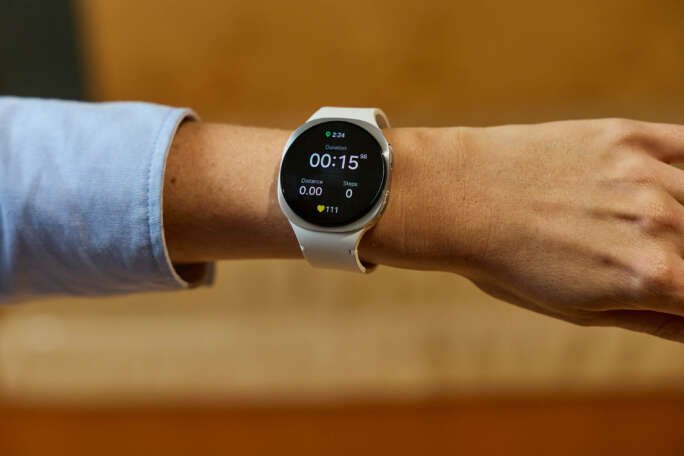
The plane leaves Sydney before lunch, a quick business-class hop north that promises sleep in the air. Somewhere over the Java Sea, I glance down at my wrist — the new Samsung Galaxy Watch8 — quietly tracking my heart rate as I drift off.
A Global Gathering on the Science of Sleep
The World Sleep Congress is a very good place to unlock humanity’s oldest mystery — why we sleep, how we can sleep better, and what happens when we don’t. This year, Samsung, with whom I am a grateful guest, took centre stage with a symposium that explores how wearable technology and next-generation digital health tools are transforming the field.
First, a group of journalists gather at the hotel conference room to meet Jongmin Choi, Vice President of Health R&D and ChonHong Ng, Vice President of Regional Marketing, Samsung Electronics Southeast Asia & Oceania from Samsung Electronics, who both introduce the company’s latest foray into sleep innovation. From a woman’s point of view, it’s fascinating to learn from these senior executives at Samsung how much women are gaining from the data received on their smart watches and smart devices. It’s something I write more about on Women Love Tech, here.
Next we head to the convention centre to apprise ourselves of the Samsung Health stand. It’s impressive. And it’s hard not to geek out on the new health products and what they can do.
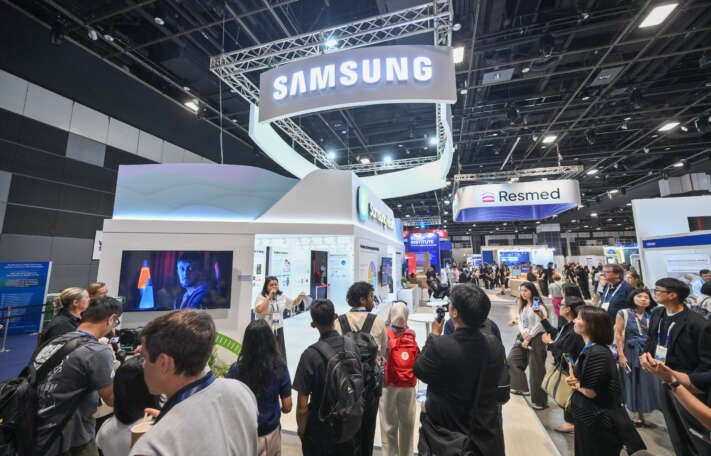
Then, we head to the session we’d all come to see.
Under the banner Transforming Sleep Science with Wearables and Next Generation Technologies: Samsung Opportunities and Case Studies, the session gathered researchers, clinicians, and digital health leaders from around the world. Chaired by Jennifer Kanady of Samsung Electronics in the U.S., the panel brings together voices from industry and academia — including the Samsung Executive team, Dr. Cecilia Caetano, Vice President of Global Medical Affairs at Bayer in Switzerland; and Professor Jaekyoung Kim from KAIST in South Korea.
They all demonstrate how technology, once dismissed as a sleep disruptor, can now be the very key to restoring it. And my take home here is that if technology is disrupting your precious sleep, then it’s likely you are using it incorrectly. So, try exploring ways your devices can actually play a positive role in restoring better sleep and help you to introduce positive sleeping habits.

From Lab to Life: The Wearable Revolution
Jennifer Kanady starts by explaining how wearables have taken sleep science beyond the lab and the benefits of continuously monitoring physiological signals in real-world settings. She says when this is done at scale, across populations, it can go on to translate that data into meaningful health outcomes.
“Wearables have taken sleep science beyond the lab — into our daily lives, and into our understanding of ourselves.” — Jennifer Kanady, Samsung Electronics
Her talk sets the tone for a new vision of health powered by insight, not intrusion.
Jongmin Choi follows with an introduction to Samsung Health, describing how the company’s ecosystem is evolving beyond tracking to interpretation by using advanced sensors and AI to identify subtle patterns in sleep, stress, and recovery.
Then Moonbae Song presents the Samsung Health SDK Suite, which enables researchers and developers to collaborate directly with Samsung’s health data infrastructure.
“The goal,” he explains, “is to empower innovation — not just within Samsung, but across the global research community.”
The Women’s Health Connection
But it is Dr. Cecilia Caetano’s case study with Bayer that strikes a particularly powerful chord. Her research explores how consumer wearables can help women better understand sleep disturbances linked to menopause.
“As women transition through menopause, hormonal fluctuations can profoundly affect sleep patterns,” she explains. “By leveraging wearable data, we’re beginning to map these changes with unprecedented precision — empowering women to take control of their wellbeing.”
It’s a critical conversation, one that often goes underrepresented in health tech. For women juggling careers, families, and modern life, poor sleep is a silent epidemic and one that needs to be addressed. Caetano’s presentation highlights how technology can offer not just insight, but validation and solutions for an experience too often overlooked. More from Dr. Cecilia Caetano is coming in a future Women Love Health story.
AI Meets Circadian Science
Professor Jaekyoung Kim of KAIST, wraps up the session with a glimpse into the future: AI + Math Meets Physiology. His team’s work uses machine learning to create personalised sleep scheduling models that adapt to each individual’s biological rhythms. At this point my brain is spinning just trying to keep up with him, and these incredible advances of AI and Maths. Here goes…
By fusing mathematics, artificial intelligence, and Samsung Health data, Kim’s research points to a world where your watch might one day anticipate fatigue before you feel it. This means suggesting when to rest, when to move, and how to align your day with your body’s natural tempo.

A Moment to Breathe
After the symposium, Christine from Samsung hosts us with a wellness immersion that mirrors its philosophy: tech-enhanced, but deeply human. There is a guided meditation, yoga, and even a running session along Singapore’s Bay area.
Each part of the session integrates with our wearables and gives us real time feedback. I am the one in the hero picture in a blue top. At this point, I look like I’ve completely drifted off … which is easy to do in such an immersive space where the walls display moving scenes of clouds and mountains. It’s not something I’ve seen in an Australian gym yet, and I can’t wait to find one that is this good.
During the session my Galaxy Watch8 tracks my heart rate, and breath, and a range of my bio markers during my moment of blissful mindfulness.
It’s easy to see how this sleek Galaxy Fold7 acts well as a portable lab — unfolding into a digital journal of health insights. And, it made me think how thoughtfully designed health products really benefit us by bringing us closer to ourselves and making us more aware of our health; the good, the bad and the ugly.
Homeward Reflections
As the Qantas flight home slips into night, the cabin darkens and the watch on my wrist vibrates softly — time for sleep mode. I recall something Kanady said: “The goal isn’t just to monitor sleep. It’s to understand it — and in doing so, to understand ourselves.”
That sentiment lingers with me as I drift off somewhere over the Timor Sea.
The world’s leading minds in sleep science are proving that rest is no longer a passive act. It’s measurable, adaptable, and essential — especially for women navigating a 24/7 world.
In an age of constant connection, Samsung’s vision feels almost radical: that the most meaningful innovation might just be helping us disconnect — to close our eyes, breathe, and simply sleep.
Note From Editor: I attended the World Sleep Congress 2025 in Singapore with a small group of journalists as a guest of Samsung Australia. This is one of my reports from the conference.